
Preliminary Geotechnical Investigation of the Proposed KwaQondile Water Supply Scheme
Client Name:
uMngeni-uThukela Water
Consulting Engineers:
SDM/Flux JV
Project Summary:
The project involved a preliminary geotechnical investigation to support the development of the KwaQondile Water Supply Scheme in the Jozini Local Municipality. The goal was to assess subsurface conditions at proposed reservoir and pump station sites to ensure structural stability and inform foundation design. The investigation included fieldwork, laboratory testing, and analysis. The outcome confirmed the presence of competent rhyolite bedrock and provided key geotechnical parameters, though laboratory results were still pending at the time of reporting.
Key Services Provided:
- Desktop study of regional and local geology using LandSat imagery and geological maps.
- Field investigation including inspection pit excavation and Dynamic Cone Penetrometer (DCP) testing.
- Soil profiling and sampling using TLB excavation and standard MCCSSO methods.
- Laboratory analysis for foundation indicators, Atterberg limits, CBR, and moisture-density relationships.
- Slope stability and runoff analysis to assess site suitability and risks.
Problem and Solution:
Initial Problem: The client needed to evaluate the geotechnical suitability of multiple sites for reservoirs and a pump station, with uncertainty around soil stability, bearing capacity, and potential groundwater issues.
Solution Provided:
We conducted a comprehensive field and laboratory investigation, identifying shallow rhyolite bedrock and variable soil conditions. DCP tests provided bearing capacity data, and soil profiles helped characterize site-specific challenges. Recommendations included foundational depth guidelines and stormwater management measures to mitigate runoff risks. The investigation confirmed the site’s feasibility for construction, pending final laboratory results.
High Quality Images
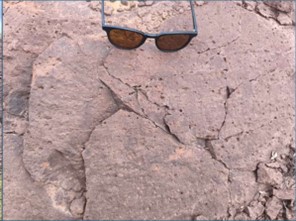
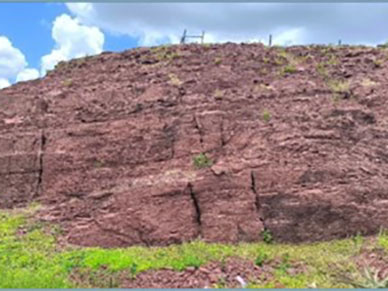
Pinkish, vesicular rhyolite which forms the bedrock geology of the area.
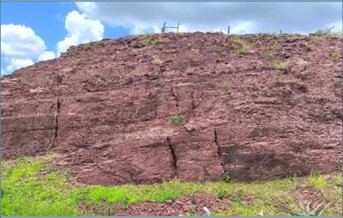
Pinkish, vesicular rhyolite which forms the bedrock geology of the area image 2
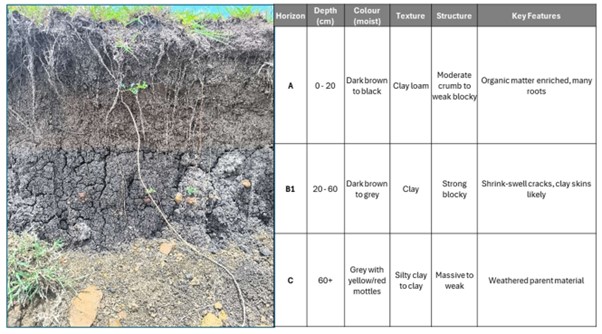
Typical soil profile at the location of the Qondile Pump Station
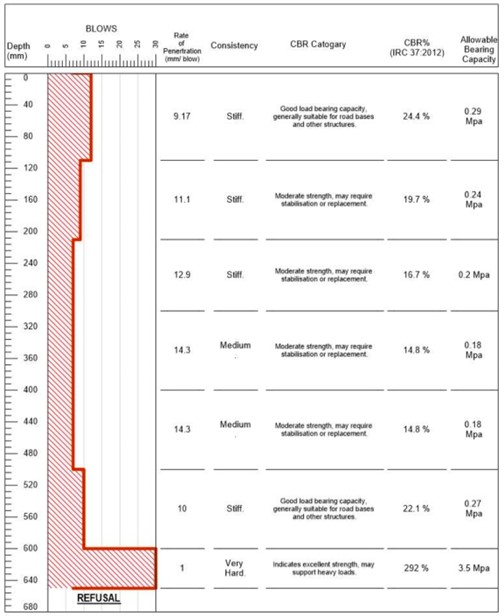
Dynamic Cone Penetrometer Test Profile
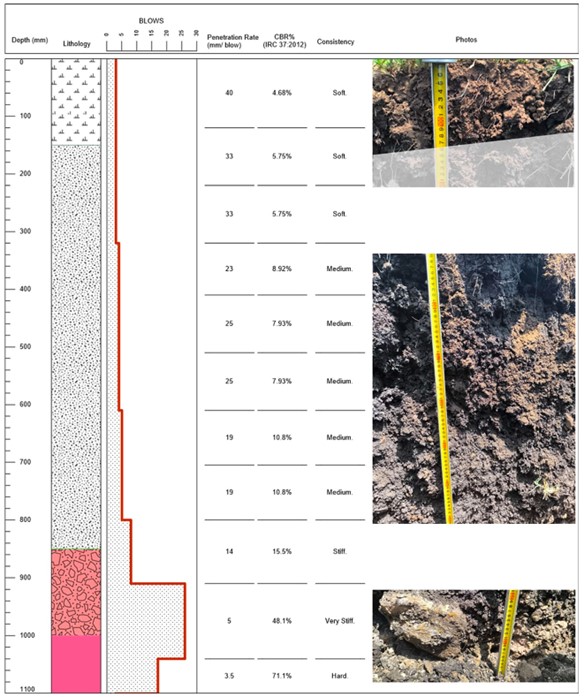
DCP Profile and Groundwater seepage test
Conclusion:
The geotechnical investigations confirmed that the proposed sites for reservoirs, pump stations, and pipelines are generally suitable for construction, though subsurface conditions vary and require site-specific engineering solutions. Shallow competent rhyolite bedrock at sites such as Majozini Reservoir and KwaQondile Pump Station offers excellent bearing capacity (>480 kPa), while other areas present softer, compressible silty clays with moderate expansiveness. No groundwater was encountered during investigations, but seasonal seepage may occur. Laboratory tests also indicated that some in-situ soils, such as those at Nkangala Reservoir, are unsuitable for backfilling due to high compressibility and erodibility.
Recommendations:
Structures should be founded directly on competent bedrock where present, while softer soils may require raft foundations or stabilized imported fill to ensure safe bearing capacity. Excavation in bedrock areas will require mechanical breaking or blasting, and slope stabilization is necessary for cuts deeper than 1.2 m. In-situ soils with poor properties should not be used for backfill; instead, suitable granular material (e.g., G5/G7) must be imported for bedding and subgrade improvement. Drainage and erosion control measures are essential in sloping areas to manage runoff and prevent surface erosion. Continuous geotechnical supervision and possible additional testing are recommended during construction to validate conditions, and all works must comply with SANS 10400, TRH14, and SAICE Guidelines.